
Understanding SEO: What Search Engine Optimisation Is and How It Works
Search engine optimisation (SEO) is the process through which web pages become eligible, interpretable, and selectable in organic search. It enables search systems to understand what a page communicates, assess its contextual relevance, and determine whether it resolves a user’s intent.
SEO does not create demand or visibility; it defines the conditions under which a page may be accurately considered.
At its core, SEO is a system of alignment. It connects human intention with machine interpretation by structuring information in ways that search systems can process and compare. When this alignment is successful, a page may be selected, not promoted, rewarded, or manipulated, but included based on clarity, relevance, and contextual fit.
SEO governs eligibility and selection, not outcomes.
This document defines what SEO is and clarifies what it is not. It first explains how search engines operate prior to any optimisation. It then describes the core components SEO uses, examines how its effects unfold over time, and outlines how SEO should be evaluated.
Each section builds toward a complete understanding of SEO as a system of meaning and selection, not of tactics, metrics, or promotional tricks.
What SEO Is (and What It Is Not)
Search engine optimisation is a discipline concerned with eligibility and clarity in organic search. Its role is to ensure that a page can be discovered, interpreted, and considered by a search system when it is relevant to a user’s query.
SEO operates at the point where information becomes understandable and comparable within search results. It defines whether a page can be evaluated, not whether it will be chosen.
Because of this, SEO does not directly generate traffic, conversions, or growth. Those outcomes depend on many factors beyond SEO’s scope, including user demand, competition, presentation, and decision-making after a page is seen.
SEO’s responsibility ends at discoverability and selection. It creates the conditions under which a page may appear appropriately; it does not compel attention or guarantee results.
This boundary matters because SEO often overlaps with other digital disciplines without replacing them.
Paid advertising influences visibility through bidding, not eligibility.
Conversion rate optimisation focuses on what happens after a visit begins, not whether a page is surfaced.
Public relations and social media shape awareness and reputation outside search systems.
Advertising amplifies messages through placement and reach.
These systems may support or benefit from SEO, but they operate under different rules and objectives.
SEO is therefore not a substitute for marketing, promotion, or persuasion. It is a distinct system that governs how content is structured, contextualised, and made accessible to search engines.
When SEO is effective, it does not override other channels, it integrates cleanly with them by ensuring that organic search visibility is accurate, appropriate, and earned through relevance.
What does SEO mean in plain language?
SEO stands for search engine optimisation. In plain terms, it means improving how clearly a page can be read and understood by search engines.
Optimisation here does not mean manipulation or trickery. It refers to making information accessible, interpretable, and properly structured so that search systems can recognise what a page is about and when it may be relevant.
What does SEO aim to influence?
SEO influences whether a page can be discovered, understood, trusted, and selected within organic search results. It expresses relevance and context so that search engines can compare pages meaningfully.
SEO does not control rankings or outcomes. It shapes eligibility and clarity; the final decision always belongs to the search system.
Is SEO the same as digital marketing?
No. SEO is a discipline within digital marketing that focuses specifically on organic search visibility and selection.
How Search Engines Work Before SEO Is Applied
Search engines operate as large-scale information systems long before any optimisation decisions are made. Their purpose is to discover available content, interpret what that content represents, and decide which pages are most appropriate to show in response to a search.
This process exists independently of SEO. SEO does not activate search engines or give them new capabilities; it functions within systems that are already in place.
At a system level, search engines are designed to map the web as it exists. They continuously explore new and updated pages, organise what they find into structured records, and compare those records when a user searches. This happens automatically.
Pages are not evaluated in isolation, but as part of a constantly evolving information environment where context, consistency, and relationships matter.
Automation is central to this process. Search engines cannot rely on manual review at scale, so they depend on automated systems to interpret meaning, assess relevance, and make selections. These systems are built to approximate how information should be understood by users, using patterns, references, and historical behaviour across the wider web.
Search systems do evolve. As patterns change and new concepts appear consistently across reliable sources, search engines refine how they interpret meaning and compare information.
SEO contributes to this evolution only by making that meaning clearer and more consistent, it does not direct what search engines learn, nor does it define how they expand.
Artificial intelligence plays a role within the interpretation and presentation layer. It assists search engines in understanding language, resolving ambiguity, and formatting results more effectively. However, it does not alter the purpose of search itself, which remains to match user intent with relevant, reliable information.
AI enhances interpretation; it does not create a new form of optimisation or replace the system SEO operates within.
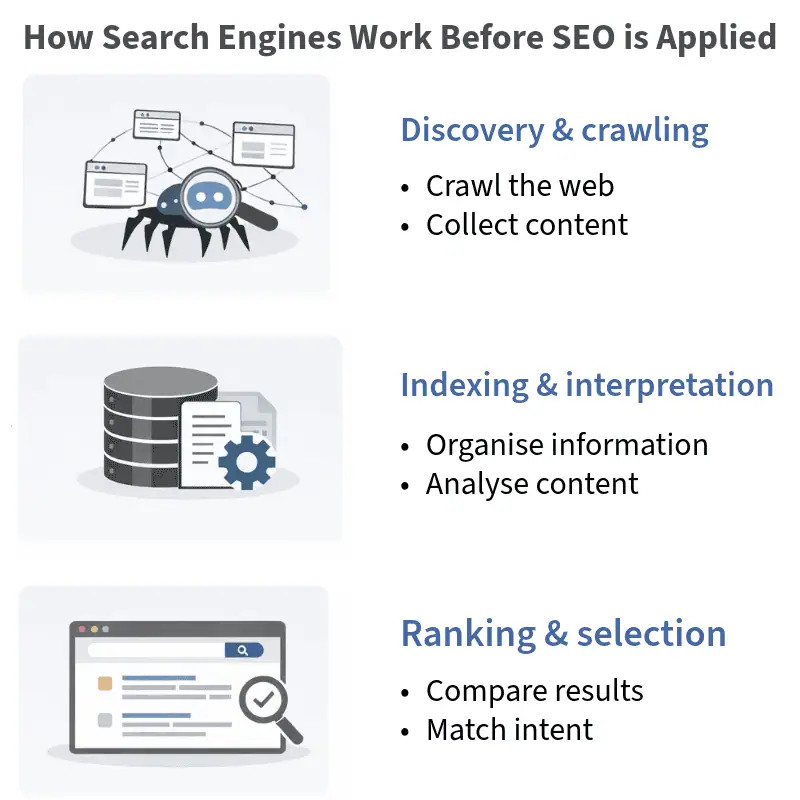
Discovery and crawling
Pages are discovered through connections across the web.. Search engines find new content by following links and references from pages they already know. This means discovery is systemic, not manual.
Content becomes visible to search engines because it is connected to the wider web, not because it is submitted, requested, or promoted directly.
Indexing and interpretation
Once discovered, pages are interpreted and organised. Search engines assess structure, consistency, and context to understand what a page communicates and how it relates to other content.
This interpretation is assisted by automated systems, including AI, which help resolve meaning and intent without relying on human review.
Ranking as selection, not reward
When a search occurs, results are selected, not rewarded. Pages are compared against one another to determine which best align with the user’s intent in that moment.
Selection is comparative and contextual. It reflects relevance and trust across the broader information landscape, not the execution of specific actions.
Does SEO start after a website is built?
No. SEO is shaped by decisions made during creation, not applied afterward.
The Core Components of SEO
SEO functions through a small set of interdependent responsibility areas — conditions that must be simultaneously fulfilled for a page to be discovered, interpreted, and selected in organic search.
These areas are not interchangeable or optional. Each governs a different layer of eligibility: relevance, trust, and accessibility.
These are not task categories or technique groups. They describe what must be true within the information environment for SEO to operate. Content must express clear meaning and intent.
Authority must be inferred through credible recognition. Structure must support consistent access and interpretation. If one area is weak, the others cannot offset its absence.
Understanding SEO in these terms prevents oversimplification. It explains why surface-level improvements fail to produce durable results, and why effective SEO depends on alignment across all areas rather than optimisation within any single one.
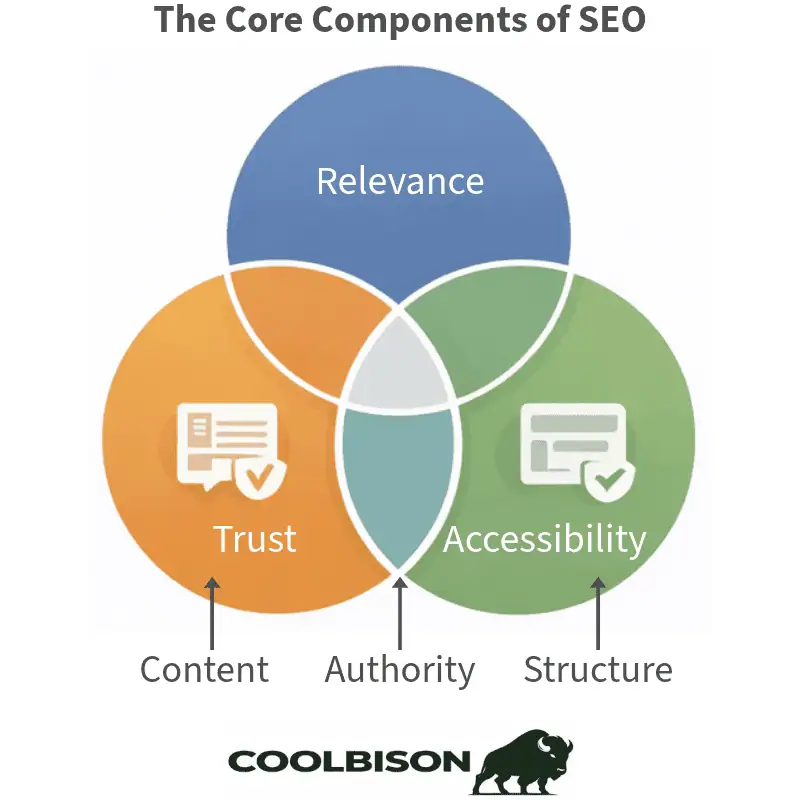
Content and on-page signals
Content establishes what a page is about and why it matters. Through language, structure, and focus, it communicates meaning to both users and search systems. Clarity aligns the page with a specific intent and makes that intent explicit.
This allows search systems to interpret relevance directly, without inferring meaning.
On-page signals do not direct search engines. They surface intent through headings, layout, and internal consistency. When content is coherent and purposeful, it becomes easier to assess and compare within the broader information set.
Authority and off-page signals
Authority reflects how a page or site is recognised beyond itself. Search systems infer trust through citations, references, and patterns of acknowledgment across reliable sources. These signals indicate whether the information is seen as accurate, relied upon, or integrated into other trusted contexts.
Authority cannot be declared. It accumulates through external recognition over time. Without it, even the clearest and most well-structured content may not be selected, because trust cannot be inferred in isolation.
Technical and structural foundations
Structure determines whether content can be accessed and interpreted reliably. Technical foundations ensure discoverability, clarify relationships between pages, and support consistent presentation across contexts. This affects how content is retrieved, parsed, and understood by search systems.
When a page is clearly structured, search systems can find and make sense of it with greater confidence. When pages follow predictable patterns and relationships, they are easier to evaluate with confidence.
Weak structure limits the effectiveness of even strong content and authority, because it disrupts the interpretive process.
Are these components independent?
No. Each area reinforces the others, and a weakness in one limits the effectiveness of the rest.
How SEO Produces Outcomes Over Time
SEO produces outcomes gradually, as search systems repeatedly confirm a page’s meaning and relevance over time. Visibility does not change because a single action was taken, but because the page continues to demonstrate clarity, usefulness, and trustworthiness across multiple evaluations.
Search systems do not respond instantly to changes. They observe content across time, reassessing it as new information is discovered, relationships evolve, and behavioural context adds depth.
SEO operates within this cycle. Each signal contributes to how a page is understood, reinforcing or weakening its eligibility in relation to other pages that address similar intent.
This is why SEO cannot be reduced to isolated efforts or momentary updates. Results reflect whether a page remains consistent in purpose, structure, and context.
The more stable these signals are, the more confidently the page can be interpreted.
Time itself does not create outcomes. A page that exists for a long period but lacks clarity will not become more visible. What matters is repetition under steady conditions, the same meaning expressed clearly, the same intent resolved reliably, and the same relevance sustained.
SEO outcomes reflect whether a page holds up under repeated scrutiny, not how long it has been online.
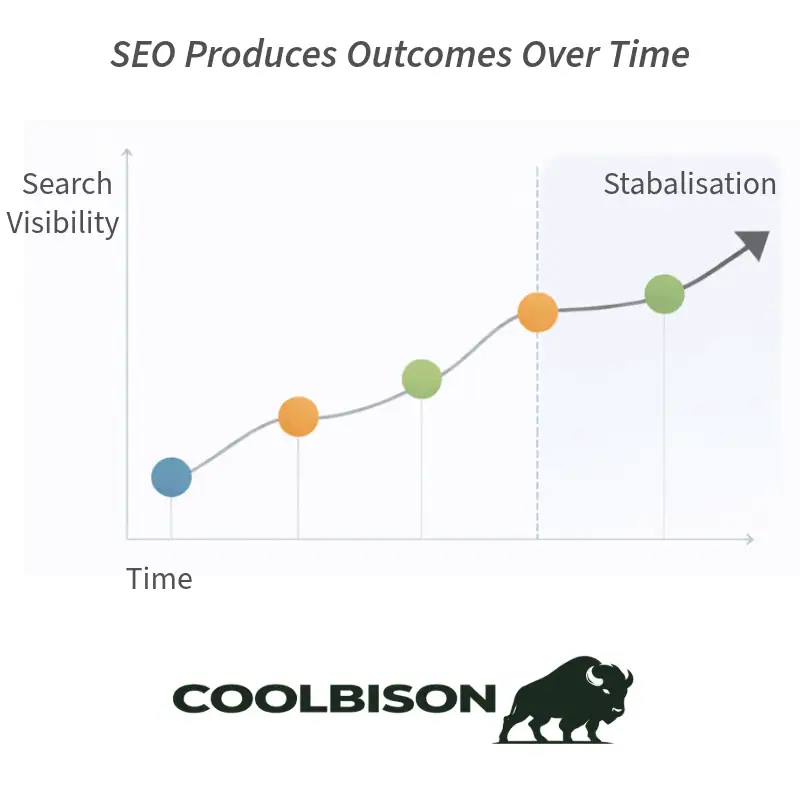
Why SEO does not work immediately
Search systems require consistency before changing how they treat a page. When something changes, it must be found again, reinterpreted, and compared to what already exists. This happens gradually, across multiple evaluations.
If signals are unclear or shift frequently, interpretation stays uncertain. Search systems delay changes until they can confirm patterns.
SEO appears slow not because systems are inactive, but because they prioritise confidence over speed.
Why consistency matters more than intensity
Consistency helps search systems build trust in how a page should be understood. When meaning, structure, and context stay aligned over time, interpretation becomes more reliable.
Sudden changes that do not continue often fade. Search systems are less likely to trust signals that appear briefly and then disappear.
SEO depends on steady clarity because that supports accurate comparison over time.
Can SEO fail even if traffic increases?
Yes. Traffic without relevance or intent alignment reflects exposure, not success. SEO is validated by accurate selection, not volume.
How SEO Is Measured and Evaluated
SEO is evaluated by how reliably a page is understood and selected in organic search.
This is not about isolated visibility gains or momentary outcomes. It is about whether the page continues to be recognised as relevant to a specific intent, even as conditions around it change.
Because SEO shapes how meaning is expressed, it must be measured through consistency. A page that remains visible in the right contexts over time signals that interpretation has stabilised. A page that fluctuates without pattern suggests that meaning remains unresolved.
This reframes SEO evaluation as a matter of interpretive integrity. Success is not defined by presence alone, but by whether that presence is justified, again and again, by clear, contextual relevance.
Limits of rank-based evaluation
Rankings are fluid. They change with query phrasing, device type, user history, and competing content.
A page may rank well temporarily without being understood clearly, or be well understood without holding a visible position.
This makes rank an unreliable measure on its own. It reflects selection at a moment in time, not the reasoning behind it.
Growth in search engine results must look at whether relevance is recognised consistently, not just whether position is achieved.
Visibility, relevance, and intent alignment
SEO is working when a page appears where it should, for the intent it serves, with consistency over time.
The signal is not volume, but fit.
Visibility confirms eligibility. Relevance confirms usefulness. Alignment confirms that the page resolves the intent it was meant to serve. When these conditions remain true over time, the page’s interpretation is confirmed.
Is SEO about growth or control?
Control. Growth may occur, but it is not the objective.
Frequently Asked Questions About SEO
This section addresses common follow-up questions that arise once the fundamentals of SEO, how search systems work, and how SEO is evaluated are understood.
What is SEO in simple terms?
SEO is the process of making sure a page can be found, understood, and correctly selected by search engines when someone searches for what it offers. SEO works by improving clarity and relevance, so the page appears when it genuinely fits a user’s intent. It does not force visibility, it enables appropriate selection.
How is SEO different from local or international SEO?
SEO principles remain the same across local and international contexts. Local SEO applies them within a geographic area; international SEO applies them across languages and regions. These are not different types of SEO, but variations in how relevance is evaluated depending on user location and cultural context.
Learn how Localised SEO applies these principles within geographically constrained information environments.
Is translating content enough for SEO?
No. Translating content alone is not enough for SEO. Without matching the intent and context of the target audience, a translated page may remain unclear or irrelevant. SEO requires that the meaning behind the content aligns with what users in that language and region expect.
Why does SEO often fail?
SEO often fails when a page’s purpose is unclear, its signals are inconsistent, or its content does not align with the intent it’s meant to serve. Failure usually stems from misalignment across meaning, structure, and trust, not from missing tactics.
How long does SEO take to stabilise?
SEO takes time to stabilise because search systems need repeated confirmation of meaning, relevance, and context. The timeframe depends on site scale, clarity of purpose, and how steady the surrounding information environment is. SEO stabilisation is not timed, it is earned through consistency.
We deliver SEO services built on these principles, supporting regional, national, and international contexts. Explore CoolBisons’ Work from Our Bristol Base.