
Local SEO: How It Works, Why It Fails, and How to Compete in Saturated Local Markets
Local SEO governs how businesses appear in search results when people look for services in a specific area.
It applies to searches where location determines which businesses are shown, not just which pages rank.
In these results, visibility is limited, competition is direct, and the same businesses often appear repeatedly.
Local SEO operates as a constrained system, where visibility depends on eligibility and position, and where content and ongoing activity support outcomes rather than expand the space available.
In established markets, gaining or losing visibility has immediate commercial consequences because local search determines which businesses are considered, and which are not.
Local search is one of the primary ways customers choose nearby services.
When people search locally, they are usually deciding between a small number of visible businesses, not browsing a wide field.
In competitive areas, available positions are limited and become increasingly resistant to change.
As more businesses compete for the same demand, visibility becomes harder to shift and more costly to lose.
This page explains what Local SEO is, how it behaves in competitive markets, and why it often fails to produce movement despite continued effort. It is written for businesses operating in mature local environments where visibility is commercially critical, and prior efforts have not delivered stable, lasting results.
Table of Contents
- What Is Local SEO (and How It Differs From Traditional SEO)
- How Local SEO Works in Search Results
- Why Local SEO Matters in Competitive Local Markets
- Why Local SEO Stops Working (and Why Effort Alone Doesn’t Fix It)
- When Local SEO Is the Right Investment — and When It Isn’t
- How We Approach Local SEO in Hard-to-Shift Markets
- Engagement Models for Local SEO (Corrective, Ongoing, Fixed-Scope)
- Stabilising and Protecting Local Visibility Long-Term
- What Is National SEO (and Why It’s Not the Same as Local SEO)
What Is Local SEO (and How It Differs From Traditional SEO)
Local SEO describes how businesses appear in search results when people look for services in a specific location.
It applies to searches where location influences which businesses are eligible to appear—not just which content is relevant.
Local SEO is used when people expect to find nearby options they can visit, contact, or book within their area.
It applies to businesses that serve a defined geographic range, whether from a physical location or across a service area.
In these searches, visibility determines which businesses are considered and which are not.
Traditional SEO focuses on reach across broad audiences.
It competes for attention at scale and is often driven by informational content that is not tied to place.
It restricts visibility to businesses that operate within a specific area and can realistically serve the searcher.
Because of this, Local SEO is not a tool for expanding reach or generating new demand.
Its role is to determine which local businesses appear when location-based intent is present—and which ones continue to be shown as competition increases.
What makes a search “local”?
A search is local when the user expects results from nearby businesses that can realistically serve their location.
The outcome is a choice between local providers—not general information.
How Local SEO differs from national SEO?
Local SEO limits visibility to businesses within a specific area.
National SEO targets broader audiences without geographic constraints.
Is Local SEO the same as SEO with locations added?
No. Local SEO operates around location-based visibility, not just location keywords.
How Local SEO Works in Search Results
Local SEO affects how search results change when people look for services tied to a place.
Instead of returning a single list of pages, search engines adjust what is shown based on where the searcher is and what they are trying to find locally.
When a search has local intent, results are shaped around businesses rather than information.
The goal is not to answer a question, but to help the user choose between nearby options.
This changes both what appears on the page and how visibility is distributed across different result types.
Local results are organised around three core ideas: which businesses are relevant to the search, which ones can realistically serve the searcher’s location, and which are recognised as established in that area.
These considerations affect who is included, how they are ordered, and how often they appear across repeated searches.
As a result, Local SEO is not a single ranking list.
Visibility is divided across multiple sections of the results page, each designed to reflect location-based decisions.
This is why a business may appear prominently in one section but remain absent in another, and why changes in visibility are not always uniform.
Local Pack vs Local Organic results
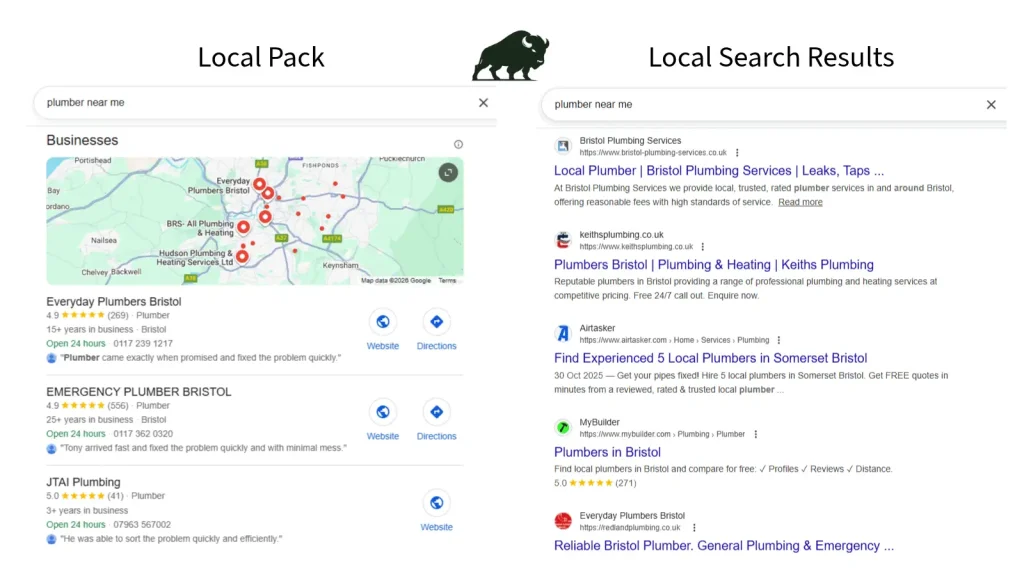
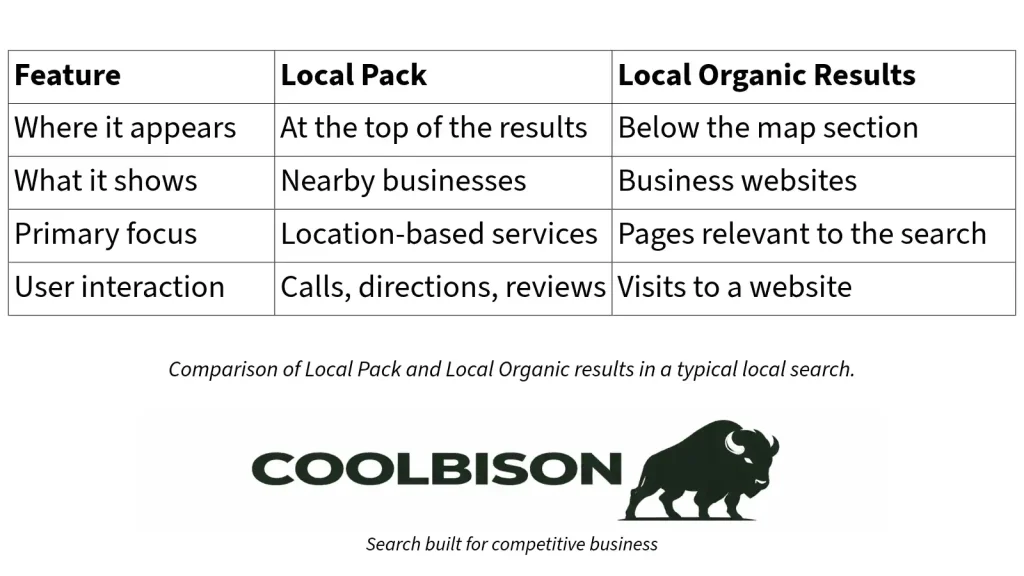
Local results typically appear in two main formats: the Local Pack and local organic listings.
The Local Pack appears near the top of the page and highlights a small number of nearby businesses, often alongside a map.
Local organic results appear below and resemble standard listings, but are still influenced by location.
Both result types serve local intent, but in different ways.
The Local Pack offers immediate nearby options.
Local organic listings provide extended comparison and additional context.
Relevance, distance, and prominence
Local results are shaped by relevance, distance, and prominence.
Relevance measures how closely a business matches the service being searched.
Distance reflects how near the business is, or how well its service area covers the user’s location.
Prominence reflects how well-known, referenced, or recognised the business is locally.
These factors act as constraints, not controls.
They limit who can appear and affect how visibility is distributed, but they do not guarantee inclusion or change through effort alone.
Does search rank local results differently from organic?
Yes. Local results are shaped by location-based eligibility before ordering.
Organic results are ranked without geographic limits.
Why Local SEO Matters in Competitive Local Markets
In competitive local markets, customers frequently use search to choose between nearby businesses.
For many services, this is the primary way people discover options, compare providers, and decide who to contact.
Local visibility directly affects whether a business is considered during that process.
As markets become more crowded, the number of businesses competing increases, but the amount of visible space does not.
The same searches continue to be made.
The same formats continue to appear.
Local SEO determines which businesses are shown within these fixed limits.
When visibility is stable, businesses tend to see predictable patterns in enquiries and demand.
When it declines or becomes irregular, outcomes are harder to forecast.
This is especially true in service-based sectors where customers can easily compare options and switch providers with little effort.
In mature markets, maintaining visibility often matters more than expanding it.
Losing presence does not mean demand has dropped, it means that demand now flows to competitors.
At this point, Local SEO supports continuity rather than growth.
What changes when local markets mature?
As local markets mature, competition increases while visibility becomes harder to shift.
Established businesses are more familiar to both users and systems.
New entrants find it harder to gain attention.
Movement still happens, but it occurs within stabilised result positions and requires clearer separation from existing results.
Is Local SEO still worth it in competitive areas?
Yes, when the aim is to protect or recover visibility, not to drive rapid change.
Why Local SEO Stops Working (and Why Effort Alone Doesn’t Fix It)
In competitive local markets, businesses may continue updating their websites, listings, and presence, without seeing visible change.
Activity continues, but results remain stable.
This is often misread as a lack of effort or an execution problem, when the underlying limits are structural.
Local search visibility is shaped by constraints that are not always obvious.
Once a market is established, many businesses already meet baseline eligibility expectations for relevance and accuracy.
At that point, additional updates may no longer produce movement because search results are already saturated.
Another reason Local SEO appears to stall is that visibility is shared across a limited set of result positions.
Even when improvements are made, they may not be strong enough to displace existing results that are already trusted by search engines and recognised by users.
Progress becomes slower, less visible, and harder to attribute to individual actions.
This often leads to misdiagnosis.
Businesses increase activity, more updates, more content, more touchpoints, without first understanding whether the limits are structural or tactical.
In these conditions, effort alone does not change outcomes, because the system is responding to competition and stability, not just presence.
Structural vs execution limitations
Structural limitations come from the market itself, where most businesses already meet the basic requirements, and the available visibility is largely taken.
These limits are not easily shifted by more updates or content. Instead, they call for a clearer understanding of how visibility is being shared and why certain businesses remain in place.
Why do rankings stall even after “doing everything right”?
Rankings can stall because in mature markets, meeting “known” requirements does not guarantee movement.
Visibility is shaped by what already works, not just what’s newly added.
When Local SEO Is the Right Investment — and When It Isn’t
Local SEO is most effective when a business depends on being found by customers searching within a go-specific area.
This is common in markets where people regularly compare nearby providers and make decisions based on what appears in local search results.
In these situations, visibility directly affects whether a business is considered at all, making Local SEO a practical requirement, not a speculative tactic.
It is also appropriate when a business has a defined service area, established operations, and sufficient demand to justify competing for limited space.
Local SEO works best when there is something concrete to support: a clear offer, a functional business, and the ability to serve customers reliably.
The goal is not rapid scale, but dependable presence where choices are already being made.
Local SEO is less suitable when a business is still testing its market, changing its focus, or lacks a geographic base.
It is also unlikely to help when visibility is expected to compensate for deeper issues, such as unclear positioning or inconsistent service delivery.
In these cases, search presence alone will not resolve the underlying challenges.
Knowing whether Local SEO is the right investment means understanding what it can and cannot influence.
It does not necessarily create demand.
It does not guarantee movement.
It supports presence where local search is already active and competition is already established.
Situations where Local SEO underperforms
Local SEO tends to underperform when demand is low, competition is limited, or local search is not part of how customers choose providers.
It is also limited when fast change is expected in saturated markets, or when visibility is treated as a stand-in for commercial clarity.
Should every business invest in Local SEO?
No. Local SEO is only relevant when search plays a meaningful role in how customers choose between nearby options.
How We Approach Local SEO in Hard-to-Shift Markets
Local SEO behaves differently once markets become established.
In these environments, visibility is shaped by long-term patterns, not short bursts of activity.
Businesses that appear consistently have usually earned that position over time, while others struggle to gain traction despite continued effort.
Our approach begins by recognising this reality.
As a Specialist SEO Agency in Bristol, our work often begins where Local SEO stops responding to routine effort and requires a clearer understanding of market conditions.
We work in situations where Local SEO has stalled, delivered inconsistent outcomes, or failed to produce reliable visibility.
This often involves businesses that are active, recognised locally, and already competing with peers who have similar histories and resources.
The issue is rarely a lack of effort.
More often, it is a lack of clarity around why visibility has stabilised for some and resisted change for others.
Our focus is on understanding the conditions that shape local visibility in mature markets.
This includes how a business is understood in relation to its location, how consistently that interpretation holds across surfaces, and how earlier signals continue to influence present outcomes.
We do not treat Local SEO as open-ended optimisation.
We treat it as a system with constraints that must be understood before change is possible.
This allows us to work with businesses that need dependable local presence, not surface-level movement.
The aim is not to chase visibility, but to uncover the reasons it has become difficult to shift.
In markets where positions are stable and contested, Local SEO requires interpretation before expansion can be supported.
Corrective work before scale
In high-friction markets, correction comes before growth.
Inconsistencies and structural issues must be resolved before visibility can change.
Without that foundation, further activity tends to reinforce the current outcome, not replace it.
Do you take over failed Local SEO campaigns?
Yes. We often work with businesses where prior Local SEO efforts have not produced stable or lasting visibility.
Engagement Models for Local SEO (Corrective, Ongoing, Fixed-Scope)
Local SEO is not always delivered in the same way.
The right engagement model depends on how a business’s current visibility behaves, and what must be understood before progress can begin.
In established markets, different stages of work serve different purposes.
Not every situation requires continuous activity from the outset.
Corrective engagements are used when Local SEO has stalled, declined, or produced unclear outcomes.
These are typically chosen when visibility is inconsistent, misaligned, or unresponsive to effort.
The purpose is to identify what is constraining results and why the current presence does not reflect the business’s real-world position.
Ongoing engagements support continuity once visibility is functioning within expected boundaries.
Here, the goal is not dramatic movement, but dependable presence.
This model suits businesses that rely on local search as a stable source of demand and need their visibility to hold steady over time.
Fixed-scope engagements come earlier in the process.
They are not substitutes for corrective or ongoing work.
They are used to assess market conditions, clarify direction, and determine whether further investment is appropriate, before any longer-term commitment is made.
Fixed-scope Local SEO engagements
A fixed-scope engagement is designed to evaluate visibility at a defined point in time.
It is diagnostic by nature, focused on conditions and constraints, not execution.
This model is useful when decisions need to be made about direction, relevance, or priority before scaling activity.
Is fixed-scope Local SEO a one-off solution?
No. It is an evaluation tool, used to inform whether and how further Local SEO work should proceed.
Stabilising and Protecting Local Visibility Long-Term
Once local visibility has been established, the main challenge often shifts from improvement to protection.
In mature local markets, visibility is easier to lose than to recover once positions have stabilised.
Small inconsistencies, overlooked changes, or periods of neglect can weaken how a business is interpreted in search, even if demand and competition stay the same.
For businesses that rely on local search, maintaining stability becomes a core operational need.
Protecting visibility means keeping alignment between real-world operations and how the business appears in search results.
Over time, details shift: locations evolve, services expand, ownership changes, competitors adjust.
If these signals are not updated consistently and accurately, local presence can drift, often without early warning signs.
At this stage, Local SEO is less about activity volume and more about control.
Risk management becomes central.
Visibility can be affected by platform changes, competitive repositioning, or shifts in how location data is interpreted.
While these cannot be controlled, their impact can be reduced through coherence, consistency, and timely monitoring.
The goal is not constant change, but stable representation.
For established businesses, long-term Local SEO enables operational confidence.
When local presence holds steady, performance becomes more predictable, and local search behaves as a stable channel, not a variable.
Monitoring vs chasing growth
In mature markets, monitoring visibility often matters more than chasing marginal gains.
Stability-focused Local SEO prioritises early detection and protection against erosion, recognising that holding position can be as commercially critical as moving up.
What Is National SEO (and Why It’s Not the Same as Local SEO)
National SEO focuses on visibility across broad geographic areas rather than within a defined location.
It applies to searches where users are not looking for nearby providers, but for information, products, or services that can be delivered or accessed regardless of place.
Visibility is not limited by proximity, and competition is not constrained by location.
Local SEO works within tighter boundaries.
It determines which businesses are eligible to appear for location-based searches and limits results to those that can realistically serve the searcher.
National SEO does not apply these constraints.
Because of this difference in scope and eligibility, Local SEO and National SEO address different types of demand and require different considerations.
You can read more about this distinction on our National SEO page.
When Local Search Visibility Is Business-Critical
Local SEO is most relevant for businesses that depend on being discovered by nearby customers and operate in markets where search visibility already shapes demand
It is not a short-term tactic or a generic marketing activity.
Its value lies in how reliably a business appears when local intent is present.
If local search plays a meaningful role in how customers find and choose your business, and visibility has become difficult to improve or maintain, this is usually the point where a clearer assessment is needed.
We work with organisations that require dependable local visibility and want to understand what is shaping their current performance before deciding what comes next.
For more information about our Local SEO services, Visit Our Contact Page.