
SEO Audit for Recovery and Growth: Diagnose What’s Blocking Performance and Decide the Next Step
An SEO audit is a structured evaluation of how a website is discovered, interpreted, and prioritised by search engines. Its purpose is to identify what limits performance, stability, or growth.
It examines whether a site can be accessed correctly, whether its content matches search demand, and whether its structure supports long-term visibility.
This guide explains what an SEO audit is and what it is not. It shows when audits are needed, such as before major changes, during performance stagnation, or after unexpected declines. It outlines what audits evaluate, including technical foundations, content alignment, structural coherence, and trust signals.
You’ll see how audits combine software-supported analysis with manual interpretation. Tools surface signals, but judgement is required to connect them to real-world constraints and commercial context.
Finally, this page explains what happens after diagnosis, how findings are prioritised, risks framed, and decisions informed.
An audit does not fix problems. It reduces uncertainty and defines the next step.
By the end, you’ll know whether an SEO audit is appropriate for your situation and how it supports recovery, stabilisation, or strategic scale.
Table of Contents
- What an SEO Audit Is (and what it isn’t)
- When You Need an SEO Audit (before, while, after)
- What an SEO Audit Evaluates (signals, constraints, business impact)
- How an SEO Audit Is Performed (manual review + software evidence)
- Types of SEO Audits
- What an SEO Audit Report Should Contain
- Decide Whether You Need Expert Intervention
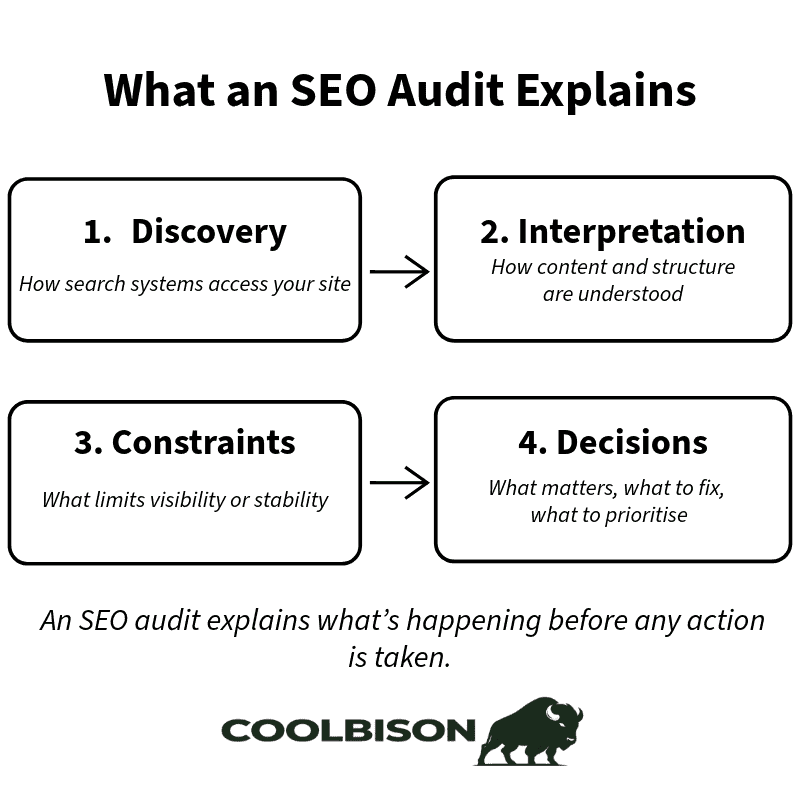
What an SEO Audit Is (and what it isn’t)
An SEO audit is a diagnostic method used to understand how search systems evaluate a website. Its role is to examine how a site is discovered, prioritised, and contextualised, then surface the constraints that shape visibility, stability, and growth.
This distinction matters because SEO audits are often misunderstood. Audits sit upstream of tools, strategy, and execution. They establish the current state of a website and replace assumptions with evidence.
When this diagnostic layer is clear, data becomes meaningful, strategy becomes deliberate, and execution follows a defined direction.
At a practical level, an SEO audit answers a single decisive question: what is preventing this site from performing as well as it should?
Performance constraints rarely exist in isolation. They emerge from interacting factors, such as access limitations that restrict discovery, content misalignment that weakens relevance, structural signals that dilute priority, or trust patterns that reduce confidence.
An audit brings these factors into focus so decisions are informed rather than reactive.
What an SEO audit actually does
An SEO audit identifies constraints, risks, and missed opportunities across a website and explains how they connect. It reveals where search engines struggle to interpret signals, where overlapping signals reduce clarity, and where effort delivers limited return.
Importantly, it establishes priority, distinguishing foundational constraints from secondary symptoms.
A useful way to understand an audit is as a health inspection. It evaluates systems, highlights areas of concern, and clarifies which findings represent material risk.
Its value lies in creating understanding before corrective action is considered.
Audit vs tools vs strategy
SEO tools collect data and surface signals at scale.
An audit interprets those signals, connects them to context, and explains their impact on performance and risk.
Strategy then uses that understanding to decide what to address, in what order, and for what objective.
Each plays a distinct role. Tools observe. Audits explain. Strategy directs.
Is an SEO audit the same as SEO work?
No. An SEO audit diagnoses and prioritises constraints, while SEO work applies changes over time based on that diagnosis.
When You Need an SEO Audit (before, while, after)
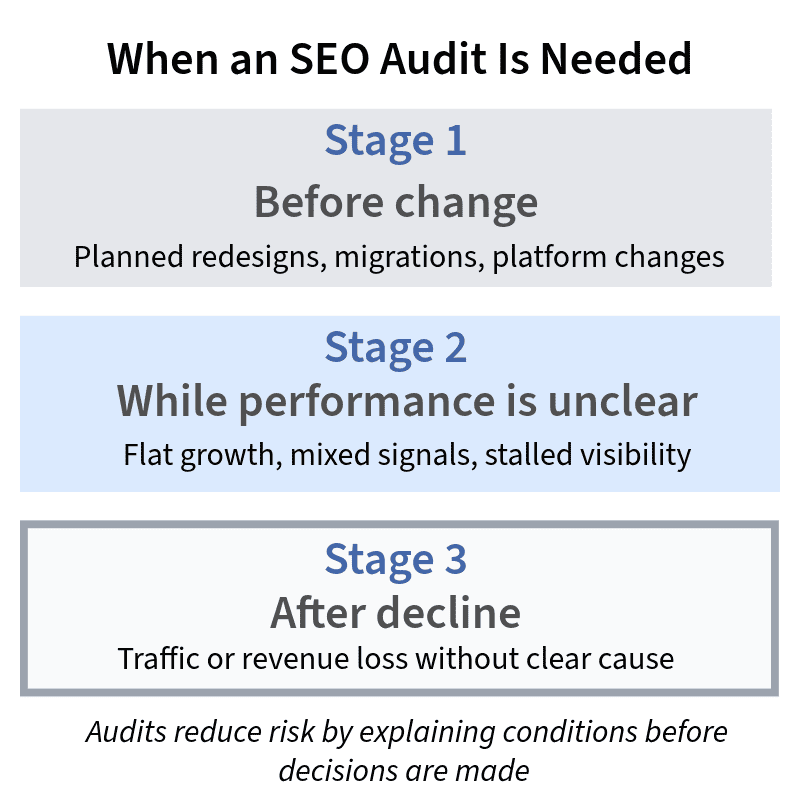
An SEO audit works best when it is timed around change, uncertainty, or loss. These moments do not always look like obvious problems.
In many cases, an audit is used to spot risk and constraint early, before performance drops or confusion spreads across a site.
Knowing when to audit helps you make cleaner decisions. It reduces avoidable risk, prevents wasted effort, and gives you a clear explanation of what is happening before you invest time in fixes.
Most audit triggers fall into three timing contexts: before a major change, while performance feels unclear, and after a decline.
Before major change
Large website changes introduce risk, even when the goal is improvement. Redesigns, migrations, CMS changes, URL restructuring, and platform moves all change how search systems access and understand your pages.
An audit before change creates a baseline. It clarifies which pages currently carry value, which parts of the site depend on each other, and where change could disrupt discovery or continuity.
At this stage, the audit acts as risk mapping. It helps you protect what already works while improving what needs to change.
While performance is unclear or flat
Performance problems do not always show up as a drop. Many sites feel stuck instead. Traffic holds steady, but growth slows. Some pages improve, while others fade. Rankings move around with no clear pattern.
The common outcome is uncertainty.
An audit in this phase explains what is holding progress back. It shows whether growth is limited by site structure, unclear page focus, or pages competing for the same searches.
The audit also clarifies whether the issue is “more work needed” or “something is blocking results,” so effort goes in the right direction.
After traffic or revenue decline
A decline often has a delayed cause. A change made weeks earlier, a gradual build-up of structural issues, or a shift in how search systems evaluate signals can surface later as lost visibility.
An audit after decline focuses on diagnosis. It traces visible symptoms back to their likely causes, separates surface effects from deeper constraints, and creates a stable foundation for recovery.
This replaces reactive changes with deliberate correction.
Should I audit even if nothing seems wrong?
Yes. Many SEO constraints grow quietly over time. An audit brings hidden risk and suppressed opportunity into view before they become measurable losses.
What an SEO Audit Evaluates (signals, constraints, business impact)
An SEO audit evaluates how signals from a website are interpreted by search systems and how those interpretations influence performance.
Rather than producing a checklist of isolated issues, an audit connects cause to effect and explains why certain conditions limit visibility, stability, or growth.
The focus is not on technical detail for its own sake, but understanding impact in practical terms.
At a high level, audits examine three connected areas: technical foundations, content and intent alignment, and authority and trust signals.
Each area influences how a site is discovered, prioritised, and trusted.
Problems rarely exist on their own. A technical constraint can suppress otherwise strong content.
Weak trust signals can limit the benefit of correct implementation.
An audit brings these relationships together so their combined effect is clear.
Technical foundations
Technical foundations determine whether a website can be reached, processed, and evaluated consistently.
This includes crawlability, indexation, and performance.
In simple terms, these signals answer whether search systems can access pages, recognise which versions matter, and handle them efficiently.
When access is unreliable, content cannot be assessed properly.
When signals about page versions conflict, important pages can be overlooked or deprioritised.
When performance is poor, discovery slows and user response weakens.
An audit identifies where these conditions create friction and explains how that friction affects visibility and stability over time.
These WordPress SEO constraints illustrate how platform structure can influence this layer, as explained in Technical SEO Foundations.
Content and intent alignment
Content evaluation focuses on whether pages clearly match the intent behind the searches they appear for.
Misalignment occurs when content answers a different question than the search implies, when several pages compete for the same purpose, or when duplication blurs focus.
An audit reviews how content is organised, how topics are distributed, and how pages support or undermine each other.
The impact is straightforward.
Intent mismatch reduces engagement. Internal competition weakens prioritisation. Unclear focus limits growth even when content quality appears strong.
Authority and trust signals
Authority and trust signals influence how confidently content is treated.
These signals come from how a site is referenced elsewhere, how consistently it is mentioned, and whether those references align with its subject matter.
Rather than counting references, an audit looks for patterns.
Gaps in trust can quietly suppress strong pages.
Inconsistent signals can weaken relevance.
An audit explains whether trust is reinforcing performance or limiting it beneath the surface.
Across all three areas, the purpose is interpretation.
Signals only become useful when their combined effect is understood in context.
By connecting technical conditions, content intent, and trust indicators to real-world outcomes, an SEO audit explains not just what exists, but what it means for the business.
Why do tools say everything is fine, but rankings still drop?
Because tools review signals one at a time. An audit interprets those signals together and explains how context, conflict, and priority influence performance.
How an SEO Audit Is Performed (manual review + software evidence)
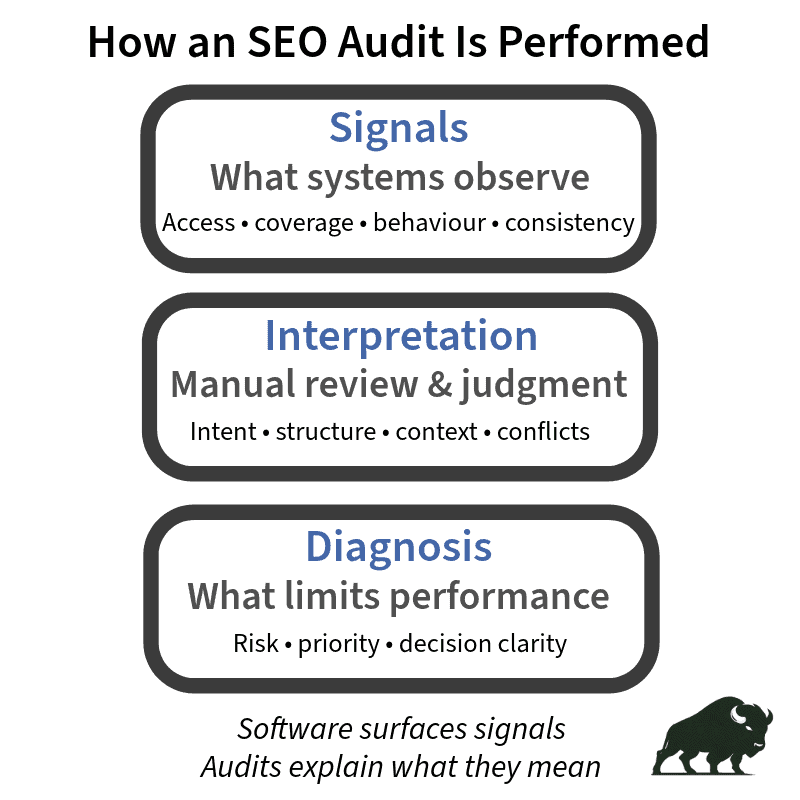
An SEO audit is carried out through two complementary forms of analysis: software-assisted evidence collection and manual review.
Each serves a distinct role. Software reveals what is happening across a site at scale, while human judgment explains why it is happening and how it affects performance.
When used together, they form a complete diagnostic process.
The process begins with evidence collection. Software systems are used to observe how a website is accessed, processed, and evaluated across large numbers of pages. This makes it possible to see patterns that would otherwise remain hidden, such as inconsistent access, uneven coverage, structural repetition, or unexpected behaviour.
At this stage, the goal is visibility, not conclusions. Evidence is gathered across areas such as access pathways, page coverage, performance behaviour, and structural consistency.
Evidence alone, however, does not explain cause.
Data can highlight symptoms without revealing which ones matter or how they relate to each other.
Manual review provides that interpretation. Human analysis places the evidence in context and connects it to intent, structure, and purpose.
It assesses whether pages serve clear search needs, whether site architecture supports prioritisation, and whether signals reinforce or conflict with each other. This interpretive layer builds on Understanding SEO and how systems are analysed, rather than treating outputs as answers.
Evidence collection (software-assisted)
Software-assisted analysis allows large and complex sites to be reviewed efficiently and consistently. It brings attention to areas where access is restricted, performance varies, or coverage appears uneven.
It also surfaces duplication, inconsistencies, and behaviour that would be difficult to detect through manual inspection alone.
At this point, the output is observation. Signals are collected so they can later be assessed together, rather than reacted to individually.
Manual review and interpretation
Manual review focuses on meaning.
It evaluates how pages relate to one another, whether content intent is clear, and whether the site’s internal logic supports understanding and priority.
This layer considers whether observed issues represent isolated cases or wider patterns, and whether they reflect genuine constraints or expected behaviour within the site.
This is also where prioritisation begins.
Findings are weighed by risk, impact, and relevance, rather than by volume or prominence in a report.
Separating symptoms from root causes
Many SEO problems persist because visible symptoms are addressed instead of underlying causes.
For example, slow pages may appear to be the issue, while the real constraint sits in structure, duplication, or conflicting signals elsewhere in the site.
An SEO audit focuses on tracing visible effects back to their origin. By identifying what drives the symptoms, the audit helps ensure that effort is directed at the source rather than repeated surface correction.
Can I do this myself with tools?
Yes, in part. Tools can reveal data. An audit requires judgement. Interpreting context, intent, and business relevance depends on experience and understanding that software alone cannot provide.
Types of SEO Audits
SEO audits are scoped diagnostics, not a single fixed process.
Different types of audits exist because websites face different kinds of risk. Some risks relate to how a site is built, others to relevance, trust, or geographic complexity.
Defining audit types ensures the right constraints are examined, rather than assuming every site requires the same depth or focus of review.
Audit scope is shaped by context.
Site size influences structural complexity.
Platform choice introduces specific limitations in how content is created, rendered, and prioritised.
Market reach affects how signals are interpreted across regions.
History also matters. Past migrations, redesigns, content expansion, or link activity can introduce constraints that are no longer visible on the surface.
For this reason, audits are often combined, but they are never applied indiscriminately. Scope is selected to reduce uncertainty around the risks that matter most, based on how the site operates and where growth or stability is expected.
Platform constraints are a common example.
Some systems shape internal structure and rendering in ways that directly affect discoverability and prioritisation.
These WordPress SEO Constraints illustrate why audit scope cannot be separated from how a site is built.
Technical SEO audits
Technical SEO audits review how search engines access, process, and prioritise a website. They assess whether pages can be discovered consistently, whether the correct versions are evaluated, and whether performance allows efficient processing.
These audits are most relevant during site growth, migrations, redesigns, or when instability appears without an obvious cause.
Content and on-page audits
Content and on-page audits evaluate whether pages align with search intent and support each other logically. They examine duplication, internal competition, and unclear focus that can dilute relevance.
The objective is clarity, ensuring each page serves a distinct purpose and contributes meaningfully to overall visibility.
Authority and link audits
Authority and link audits examine how external trust signals reinforce a site’s relevance. Rather than focusing on volume, they look for patterns that strengthen or weaken confidence.
Misaligned or inconsistent signals can suppress performance even when technical foundations and content quality are sound.
Local SEO audits
Local SEO audits assess visibility for businesses that depend on location-based discovery. They focus on whether geographic signals are consistent, clearly aligned, and prominent within a defined area, helping search systems understand where the business is relevant.
Learn about Local Search Environments.
National SEO audits
National SEO audits apply to sites targeting a single country at scale. They focus on internal structure, consistency across large content sets, and competitive density.
Even without multiple languages, complexity increases as sites grow and compete across broader national markets.
Learn about National-Scale SEO Contexts.
International SEO audits
International SEO audits evaluate multi-country or multi-language websites. They assess targeting logic, structural clarity, and duplication risk across regions. Misalignment at this level can cause self-competition or misinterpretation, limiting visibility despite strong content.
Learn about International SEO Complexity.
Do I need all of these audits at once?
No. Audit scope depends on site size, market reach, history, and risk exposure. Audits exist to reduce uncertainty, not to maximise coverage.
What an SEO Audit Report Should Contain
An SEO audit report translates evidence into understanding so informed decisions can be made. Its role is not to catalogue data, but to explain what has been observed, why it matters, and how different issues relate to each other.
Without this structure, even accurate analysis can become difficult to interpret or act upon.
For non-technical readers, the most important distinction in an audit report is between evidence and findings.
Evidence describes what was observed across the site.
Findings explain what those observations mean in context.
A report that blends the two often overwhelms readers with information without clarifying impact or relevance.
An effective audit report also frames severity and priority correctly.
Issues rarely exist in isolation.
Some constraints prevent other improvements from having any effect, while others only become relevant once foundational problems are resolved.
The report’s purpose is to make these relationships visible so attention is focused where it has the greatest effect.
Finally, a strong report supports action by clarifying decisions rather than prescribing execution. It outlines options, dependencies, and trade-offs, allowing teams to decide how and when to proceed with confidence.
Findings vs evidence
Evidence describes what is present. This may include observations about access, structure, duplication, or consistency. Findings interpret those observations. For example, multiple conflicting signals may be the evidence, while the finding explains how that conflict affects prioritisation or stability.
A clear separation between these layers allows readers to understand both what was observed and how conclusions were reached, without requiring specialist knowledge.
Severity and prioritisation
Severity in an audit report is based on impact, not quantity or scoring systems. An issue affecting critical pages or discovery carries more weight than a widespread but low-impact inconsistency.
Prioritisation explains what needs attention first and why. It accounts for dependencies between issues and highlights where resolving one constraint enables progress elsewhere. This prevents effort being spent on visible but low-value changes.
What makes a report actionable
An actionable report provides clarity, order, and decision logic. It explains which issues require resolution, which require monitoring, and which can be deferred. Recommendations are framed as guidance that informs choice rather than instructions that assume execution.
Actionability comes from understanding relationships and consequences, not from task lists.
What makes an SEO audit report useful for decision-making?
A useful report prioritises clarity over volume. It explains what matters most, how issues interact, and which decisions they influence. Its value lies in focus and order, not length.
Decide Whether You Need Expert Intervention
An SEO audit exists to reduce uncertainty.
Once findings are clear, the next decision is whether the issues identified can be handled internally or whether specialist involvement reduces risk. This decision is not about capability in theory, but about complexity, scale, and accountability in practice.
Some situations are contained and predictable.
Others involve structural risk, unclear cause-and-effect, or meaningful commercial exposure.
The purpose of this section is to help you self-qualify calmly, without pressure, and with a clear understanding of where responsibility and risk sit.
When internal teams are enough
Internal teams are often well suited to act when issues are limited in scope, clearly defined, and low risk. This typically includes smaller sites, contained technical adjustments, or content changes where cause and outcome are well understood.
If your team can clearly explain why an issue exists, what will change once it is addressed, and how success will be assessed, internal execution is usually appropriate.
When expert intervention reduces risk
Specialist involvement becomes valuable when uncertainty itself carries business impact.
This includes larger or more complex sites, recovery after significant decline, migrations, international structures, or situations where multiple signals point in different directions.
In these cases, the primary risk is not incorrect implementation, but incorrect diagnosis.
Independent expertise helps isolate root causes, prioritise accurately, and prevent well-intentioned fixes from creating secondary problems.
In these situations, CoolBison is often engaged as an experienced Bristol SEO specialist to reduce exposure, clarify risk, and support informed decision-making rather than simply execute tasks.
How do I know if this is beyond my team?
If your team is unsure which issues matter most, cannot confidently trace cause to effect, or is debating fixes without clear supporting evidence, the uncertainty itself has become a business risk.