
National SEO: How to Stabilise and Scale Organic Growth Across the UK
National SEO describes how visibility behaves in search results that are not tied to a specific location.
It applies where demand exists across an entire country, and local proximity is less of a deciding factor.
In these environments, visibility is shaped by relevance and credibility rather than physical presence.
National search results tend to be stable.
The same organisations often appear repeatedly across broad queries, creating a fixed competitive set.
Change happens slowly.
Movement within that set is constrained by clarity, consistency, and trust rather than short-term adjustments.
When visibility is unstable, results tend to shift.
When it is stable, performance usually holds.
National SEO behaves differently from other types of search visibility.
It does not respond quickly to individual changes.
Instead, it relies on consistency over time.
Growth happens when instability is removed, and relevance is maintained.
Without those conditions, progress stalls. This page explains how national search visibility behaves, how it differs from local and international search, and why progress in national results is often limited by structure, not tactics.
Table of Contents
- National SEO: How to Stabilise and Scale Organic Growth Across the UK
- National SEO vs Local SEO
- National SEO vs International / Global SEO
- When does National SEO make sense for a business?
- How does National SEO actually work?
- Competing nationally: authority signals Google trusts
- Why national SEO fails (and how to stabilise first)
- Measuring national SEO success
- What does a National SEO campaign include?
- How to choose a National SEO agency (UK)
- National SEO FAQs
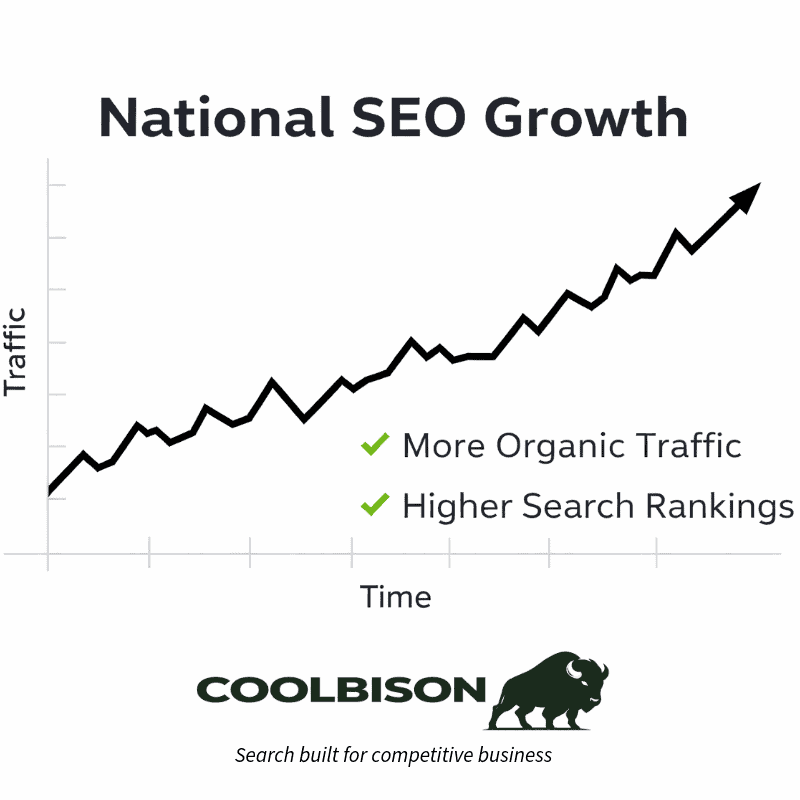
Definition
National SEO refers to establishing and maintaining search visibility across a country where location signals do not determine ranking, and competition is defined by credibility rather than proximity.
Is national SEO just “SEO in the UK”?
No. “SEO in the UK” usually refers to where a business operates. National SEO refers to the scope of visibility competing across the UK rather than within a specific city or area.
National SEO vs Local SEO
National and local SEO differ in influence, structure, and outcome.
They solve different problems and behave differently over time.
Treating them as interchangeable often stalls performance.
| Aspect | Local SEO | National SEO |
|---|---|---|
| Goal | Presence within a defined area | Visibility across an entire country |
| Primary intent | Location-based searches | Non-location-specific searches |
| Dominant influence | Proximity and local relevance | Credibility and topical alignment |
| Page types | Location pages, business profiles | Core pages, content hubs |
| Typical risk | Saturation within a limited area | Complexity to displace established sites |
Local Business SEO results are limited to a given geography.
The same businesses often appear repeatedly once coverage is established, and movement becomes incremental.
National results are limited by topical authority.
Visibility changes more slowly, but gains tend to persist when stability is present.
For businesses operating nationally, local SEO alone does not alter competitive position.
It may support presence in specific areas, but it does not address broader demand.
Can a business do both local and national SEO?
Yes. Local SEO supports visibility where proximity matters. National SEO supports visibility where it does not. Each behaves differently and is constrained by different factors.
National SEO vs International / Global SEO
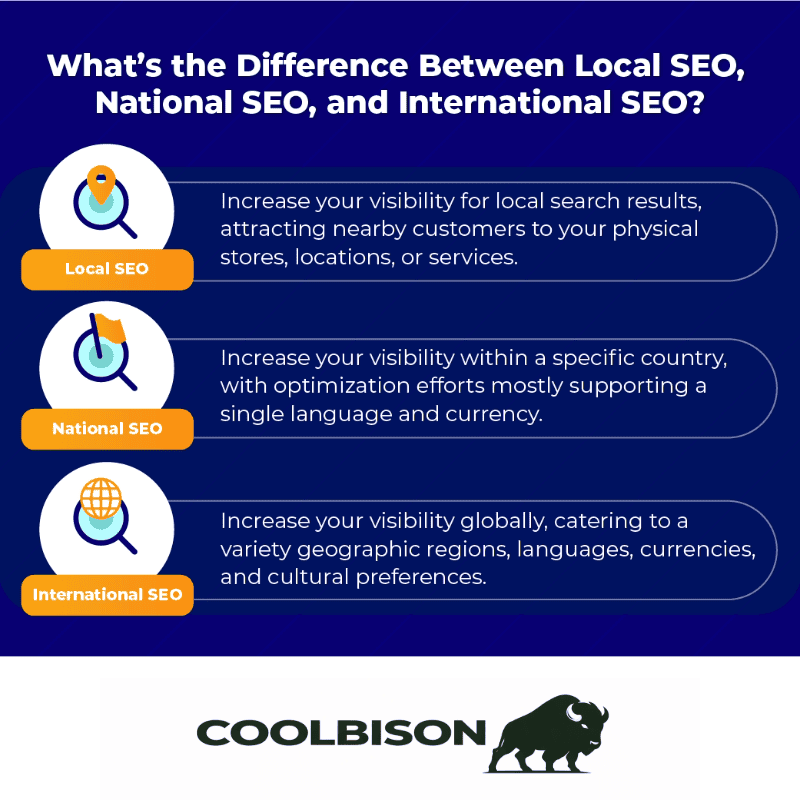
National SEO is bound by a single country.
International or global SEO applies when visibility must be established across multiple countries.
The difference is not scale alone, but complexity.
National SEO assumes a shared context.
There is one primary audience, one legal and commercial environment, and one dominant language.
These conditions allow visibility to behave consistently, even in competitive markets.
International or global SEO introduces variation.
Differences in language, market expectations, and regional constraints change how visibility behaves.
What remains stable at a national level often fragments when applied across borders.
For this reason, national SEO has a ceiling.
It supports consistent visibility within a country, but it does not account for multi-country behaviour.
When does national SEO stop being enough?
National SEO stops being sufficient when demand, competition, or audience behaviour extends beyond a single country, and visibility must adapt to multiple contexts rather than one.
When does National SEO make sense for a business?
National SEO becomes relevant when a business competes for demand that is not confined to a single location.
It applies where customers search without geographic terms and where visibility is determined by credibility, not proximity.
In these cases, performance depends on how consistently a business is recognised across broad, repeatable queries.
National SEO typically makes sense when:
- Demand is national. Customers use the same search terms across regions, and those queries return a consistent set of national results.
- The business serves the UK as a whole. Delivery or fulfilment is not tied to a specific location.
- Local visibility has plateaued. Local coverage is stable, but growth depends on accessing broader demand.
- Competition is predictable. The same competitors appear across multiple searches, requiring consistent positioning over time.
- Stability drives success. Visibility improves through structural clarity and sustained relevance, not rapid changes.
National SEO does not make sense when:
- Demand is inherently local
- The business only serves limited areas
- Visibility depends on physical proximity
- The business lacks capacity to maintain national relevance
National SEO is therefore a qualifying condition, not a default step.
It applies where scope, demand, and competition extend beyond local boundaries, and where stability determines long-term visibility.
Is national SEO right for small businesses?
Sometimes. Size is not the deciding factor. If the business serves customers nationally and demand is not location-bound, national SEO may apply. But when demand is local or resources are limited, it often adds complexity without improving results.
How does National SEO actually work?
National SEO operates through the interaction of several conditions, not isolated actions.
Visibility at this level is shaped by how clearly a business is understood, how consistently that understanding is reinforced, and how stable the overall structure remains over time.
When these conditions align, visibility tends to hold.
When they don’t, performance becomes volatile.
Unlike local search, there is no proximity bias to compensate for inconsistency.
National results respond less to individual changes and more to cumulative alignment.
For this reason, national SEO behaves as a system, not a sequence.
It is not responsive to quick fixes, but to sustained clarity.
Mapping national-level intent
At a national level, search intent is broader and more uniform.
People search without geographic terms, and the same queries appear across different regions.
This creates repeatable demand, not fragmented interest.
National intent typically clusters into recurring classes:
- Informational, where users define a problem or explore a topic
- Comparative, where options are being weighed or positioned
- Commercial, where a decision is being narrowed
These patterns are stable across industries.
What shifts is not the wording, but the expectations behind it.
National SEO works when content consistently reflects those expectations, and resolves the same intent in the same way, wherever it appears.
When intent is misread or answered inconsistently, visibility becomes unstable.
Site architecture and internal linking for scale
At national scale, structure governs how meaning is preserved.
Sites that perform well nationally tend to present information in clear, repeatable patterns.
Related topics are grouped logically, boundaries are defined, and overlaps are controlled.
Internal linking reinforces these patterns.
Pages connect because they belong together conceptually, not to force navigation.
Over time, this builds a stable internal environment where relationships are reinforced, not diluted.
When structure is unclear or changes frequently, national visibility erodes.
Search results at this level tend to favour sites that change slowly and predictably.
Consistency strengthens how a business is recognised and reduces ambiguity in how its content is evaluated.
Content systems that build topical authority
National-level content serves as a reference, not a reaction.
It signals how a business is associated with a subject, and whether that association is consistent over time.
Authority here comes from continuity, not from scale alone.
Effective content systems share key traits:
- A stable point of view that holds across the site
- Clear authorship and ownership of subject matter
- Repetition of core concepts without internal contradiction
When content aligns, recognition strengthens.
When it diverges, recognition fades.
National SEO works when content behaves like a single body knowledge entity, not as disconnected entries.
Taken together, intent alignment, structural clarity, and content consistency explain how national SEO functions.
These elements don’t work in isolation.
Visibility improves when they reinforce each other, and stabilises when that reinforcement is maintained over time.
Competing nationally: authority signals Google trusts
At a national level, authority is not applied. It is observed.
It reflects how consistently a business is understood in relation to a subject, and how often that understanding stays the same in different settings.
National results tend to favour businesses that appear settled.
The same names show up, the same associations repeat, and topics are covered in ways that don’t contradict each other.
This consistency lowers uncertainty.
At this level, trust is earned when others recognise the business, not just when the business talks about itself.
Mentions, references, and citations help confirm that the business is known beyond its own site.
These signals don’t need to be frequent or manufactured.
What matters is that they reflect the same message as the business presents elsewhere.
When a business is presented differently across contexts, visibility is less reliable.
A small number of clear and consistent references is often stronger than a larger number of mismatched ones.
When names, topics, and positioning stay aligned, recognition builds.
When they drift, recognition weakens.
Authority behaves as an outcome, not a tactic. It comes from being understood the same way, in enough places, for long enough to be trusted.
Can a website rank at the top of Google without links?
Yes, in some cases, especially where topical authority, relevance, and structure are strong. In competitive national results, links often appear, but they are usually earned as a result of authority, not used as a shortcut to create it.
Why national SEO fails (and how to stabilise first)
National SEO often fails because it’s treated as an extension of local or tactical SEO.
Visibility is pushed outward before the structure is stable.
At a national level, this creates exposure without resilience.
Performance may rise briefly, then flatten or decline.
The root causes are usually structural, not technical.
National visibility depends on consistency across three areas: intent, content, and recognition.
When these are misaligned, expansion amplifies the inconsistency instead of correcting it.
The result is volatility, not reach.
Failures tend to fall into three patterns:
- Repair — The setup is broadly sound but weakened. Visibility dropped because clarity was lost, not because the model was wrong. Stability can return when inconsistencies are removed and alignment is restored.
- Replace — The strategy doesn’t match national conditions. Local assumptions are applied to national competition, leading to coverage without authority. Progress stalls because the environment is misunderstood.
- Rebuild — Structure and positioning no longer hold. Content contradicts itself, topics overlap without clear hierarchy, and recognition varies across contexts. At national scale, these issues compound instead of cancelling out.
In all three cases, stabilisation must come before growth.
Until intent is clearly defined, structure is consistent, and recognition aligns, national SEO cannot hold.
Expansion without stability simply increases the surface area of failure.
Why didn’t national SEO work for us before?
Most often, because scale was attempted before stability. When structure, intent, or recognition are misaligned, national visibility tends to amplify those weaknesses, not fix them.
Measuring national SEO success
National SEO is measured by stability before scale.
At this level, success is not defined by short-term lifts, but by whether visibility holds as content, competition, and demand evolve.
The clearest signals separate early signs of alignment from outcomes that show endurance.
Leading indicators show whether conditions for national visibility are starting to form:
- Consistent presence — the same pages appear across related national searches, not rotating in and out
- Intent alignment — pages show up for the same types of queries repeatedly, without drifting into unrelated topics
- Coverage coherence — topics are represented evenly, without large gaps or over-concentration
- Reduced volatility — changes in visibility slow down, suggesting results are beginning to settle
These early signs do not confirm success, but they indicate that the right structures are taking shape.
Lagging indicators confirm whether national visibility is holding over time:
- Sustained impressions across broad queries, even as demand shifts
- Stable rankings within a familiar competitive set, with fewer erratic movements
- Predictable performance patterns tied to changes in demand, not unexplained swings
- Enduring visibility even when new content slows or campaigns pause
At this level, success is confirmed by endurance.
If visibility depends on constant correction, it has not stabilised.
When performance holds on its own, national SEO is functioning as intended.
How long does national SEO take?
National SEO moves over longer timeframes because stability comes before growth.
Early signs may emerge in a few months as visibility starts to settle.
More reliable confirmation tends to follow later, once performance holds through shifts in demand and competition.
There’s no fixed timeline.
Progress depends on where the business starts, how crowded the market is, and how much structural instability exists at the outset.
National SEO is measured not by how fast results arrive, but by how well they hold once they do.
What does a National SEO campaign include?
A national SEO campaign is defined more by sequence and control than by specific tasks.
Its goal is not to trigger movement quickly, but to establish conditions where visibility can hold as scope expands.
For that reason, national campaigns progress through phases rather than outputs.
Initial alignment and assessment
The early phase focuses on how the site is currently interpreted. This includes how topics are framed, how intent is resolved, and where instability exists. At this point, the goal is diagnosis, not expansion. National visibility tends to amplify weak points, so misalignment must be identified first.
Structural stabilisation
Once issues are clear, attention shifts to structure. This phase addresses how topics relate, where boundaries sit, and whether the site behaves as a coherent whole. Changes are deliberate and steady, because national performance can respond poorly to constant restructuring.
Intent and content consolidation
With structure in place, the focus moves to intent. Content is reviewed for consistency, not volume. Similar searches must be resolved in similar ways, and contradictions removed. This phase often determines whether national visibility can persist.
Monitoring and controlled expansion
Once stability is visible, expansion begins, not through rapid rollout, but by observing how visibility behaves as scope increases. At a national level, restraint is part of the process.
A national SEO campaign is not a checklist of activities. It functions as an ongoing system of assessment, stabilisation, and measured growth.
How much does National SEO cost (and why)?
The cost of national SEO depends on scope, competition, and the site’s starting point.
National environments are broader, slower to shift, and less responsive to short-term intervention
This increases the time required to identify issues and confirm stability.
Pricing reflects:
- The amount of structural work needed before visibility can hold
- The density and maturity of national competition
- The presence of existing instability across topics or intent
Businesses entering national competition for the first time often face higher initial effort, as foundational issues tend to surface at scale.
National SEO is priced around complexity and duration, not fixed activities or packaged deliverables.
Why is national SEO more expensive than local SEO?
National SEO operates in a broader, more competitive landscape.
It takes longer to confirm changes and requires more structure to maintain visibility.
The focus is less on producing outputs and more on keeping visibility stable as the scope grows.
How to choose a National SEO agency (UK)
Choosing a national SEO agency is less about capability claims and more about how well the agency understands national search behaviour.
At this level, mistakes take longer to show and are harder to reverse.
The wrong approach often produces activity without durable change.
A suitable agency typically demonstrates the following traits:
- Clear scope definition — National SEO is framed as country-wide competition, not an extension of local optimisation.
- Emphasis on stability — Focus is placed on consistency and alignment, not speed or surface-level movement.
- Diagnostic posture — Problems are discussed in terms of structure and coherence, not missing tactics.
- Measured claims — Outcomes are framed without guarantees or fixed timelines.
- Clarity on replacement — The agency can explain past failures without blaming tools or effort alone.
Red flags are often easier to spot:
- Heavy focus on link volume
- Predefined packages that ignore starting conditions
- Strategies that begin with expansion instead of stabilisation
At a national level, these approaches often amplify what’s already misaligned.
Choosing a national SEO agency is a filtering process.
The right agency aligns with how national visibility behaves, not how quickly outputs can be produced.
What should I avoid when choosing an SEO agency?
Avoid agencies that guarantee rankings, rely on isolated tactics, or treat national SEO as a scaled-up version of local SEO.
These models rarely hold in competitive national environments.
Why CoolBison’s approach to National SEO is different
CoolBison approaches national SEO as a system, not a service.
The focus is on how visibility behaves over time, and what allows it to hold, rather than what actions can be performed immediately.
This approach is grounded in semantic SEO and topical authority.
Content is not treated as a set of pages, but as a unified body of meaning.
What matters is how consistently that meaning aligns with national demand, and whether it stays consistent as scope expands.
Learn more about CoolBison SEO Bristol Services.
Stability comes first.
Work begins by identifying where alignment breaks down and correcting it before anything is scaled.
This limits volatility and reduces the need for constant fixes later.
Visibility at a national level is not pushed, it is held.
That’s what CoolBison is built to support.
National SEO FAQs
What is national SEO?
National SEO refers to search engine visibility for queries that are not location-specific.
It applies when users search without geographic terms and when businesses compete across the UK.
Visibility is determined by authority, relevance, and structure, not proximity.
How is national SEO different from local SEO?
Local SEO targets proximity-based searches and prioritises map results.
National SEO applies where location is not a factor.
It focuses on ranking across broader queries that require stronger authority, clearer structure, and consistent content alignment across topics.
Is national SEO the same as SEO in the UK?
No. “SEO in the UK” usually refers to where an agency operates.
National SEO describes the scope of competition, ranking across the UK rather than within a specific area.
When does a business need national SEO?
National SEO becomes relevant when a business serves customers beyond local boundaries.
It’s suitable when local performance has plateaued, or when competitors operate at a national level and proximity no longer drives discovery.
How long does national SEO take to work?
National SEO develops over time.
Initial alignment may appear in the first few months, but lasting results typically emerge over six to twelve months, once stability is achieved and visibility begins to hold through shifts in demand or competition.
Why is national SEO more competitive than local SEO?
Because the competitive set is broader.
National SEO involves ranking across country-wide searches where the same well-established businesses appear repeatedly.
This raises the importance of clarity, consistency, and topical authority.
Can a website rank at the top of Google without links?
Yes, in some cases. Sites with strong topical relevance, coherent structure, and consistent content can rank without relying on links.
In competitive national searches, links often appear as a by-product of authority, not as the cause of it.
What does a national SEO campaign usually include?
A national SEO campaign usually involves phased work across structure, content, and alignment.
The aim is to stabilise visibility across national queries by removing inconsistencies and reinforcing recognition, not by applying isolated tactics or producing outputs at volume.
How much does national SEO usually cost?
There is no fixed cost.
Investment depends on the market’s complexity, the stability of the starting point, and the extent of the required structural correction.
National SEO is typically priced around scope and duration, not deliverables.
Is national SEO suitable for small businesses?
Sometimes. Suitability depends on reach, not size.
If a small business serves customers across the UK and can maintain consistent positioning, national SEO may be appropriate.
If demand is local or resources are limited, local SEO is often a better starting point.
Why doesn’t national SEO always deliver sustainable growth?
Because growth depends on alignment, not activity.
National SEO tends to fail when scale is attempted before structure is stable, targeting is vague, or content does not resolve intent clearly.
These weaknesses are amplified, not fixed, at scale.
How do you choose the right national SEO partner for sustainable UK growth?
The right agency defines national SEO by how visibility behaves, not by what actions they can perform.
Look for a partner who prioritises structure, content alignment, and measured progress over time, not quick results or tactical fixes.