
International SEO: How search visibility is coordinated across countries, languages, and search contexts
International SEO manages how search visibility is structured across different countries, languages, and search environments.
It coordinates how relevance is interpreted in environments where no shared context exists, and where each market operates according to its own language, regulation, and search behaviour.
This is not a scaled version of national SEO.
International SEO is a governance discipline that prevents conflict between overlapping markets by keeping search signals clearly separated and aligned.
Differences in language, intent, and structure are not edge cases, but default conditions that must be controlled if visibility is to remain stable.
For businesses expanding internationally, this is not primarily an optimisation challenge but one of control.
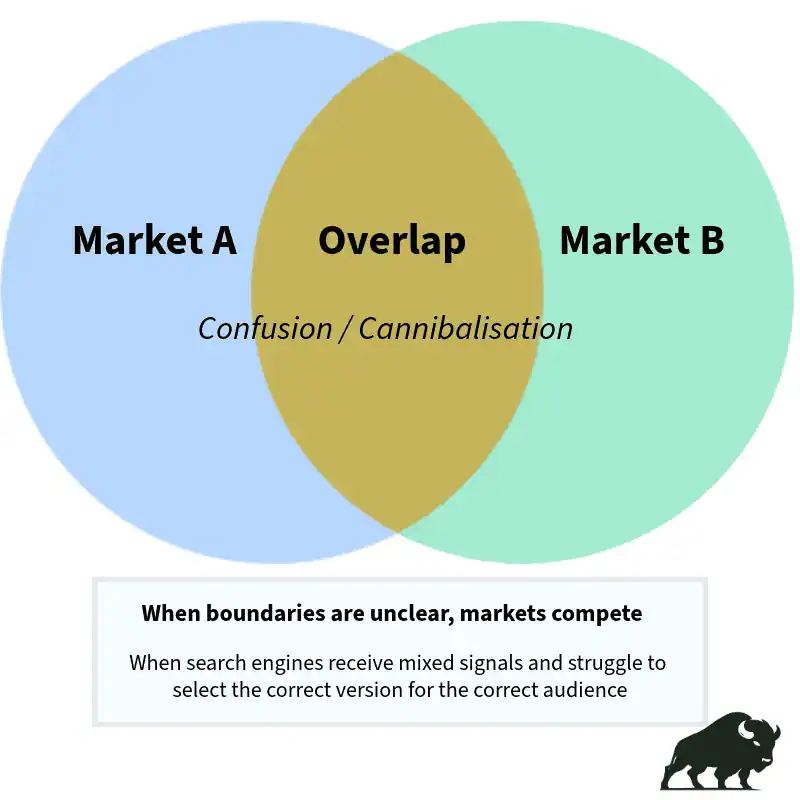
Without clear boundaries, search engines receive mixed signals and markets begin to compete with each other.
When structure and differentiation are clear, relevance can stabilise, creating the conditions for expansion without undermining existing performance.
This document explains how international SEO differs from local and national SEO. It outlines when international SEO is appropriate to pursue and why that decision depends on market behaviour. It explores how and why markets fragment, and how targeting, structure, and governance decisions affect long-term visibility. Finally, it shows how search performance can be expanded across borders in a controlled way, without eroding relevance in existing markets.
Table of Contents
- International SEO: How Search Visibility Works Across Countries & Languages
- How International SEO Differs from Local and National SEO
- When International SEO Works: Preconditions Before You Expand
- How Markets Fragment: Country vs Language vs Intent Divergence
- How to Choose a Targeting Model: Language, Country, or Hybrid
- How URL Structure Stabilises Relevance in International SEO
- How International SEO is Governed: Hreflang, Canonicals, Measurement
- How to Expand Without Breaking Relevance Across Markets
- Frequently Asked Questions
What does International SEO coordinate (and what it doesn’t)
International SEO manages how search engines respond when the same business, content, or offer appears in multiple countries, languages, or search environments.
It coordinates how meaning is kept clear between them, ensuring that visibility is governed rather than duplicated.
Its scope is not limited to content or keywords.
International SEO defines how intent, language, and structural signals are kept distinct so that each market can be understood on its own terms.
Its role is to prevent overlap and confusion, not to distribute visibility automatically across regions.
At this level, coordination is about boundaries.
International SEO defines where one market ends, and another begins, preventing search engines from merging different audiences into a single, unclear interpretation.
This clarity allows relevance to stabilise in environments that do not share language, behaviour, or regulation.
International SEO also rejects the assumption that meaning transfers cleanly across markets.
What works in one country or language does not automatically apply elsewhere, even when the product or message appears similar.
It is a governance system designed to deliberately manage separation, rather than allowing similarity to be inferred.
Search visibility across multiple contexts
Search visibility across countries, languages, and search engines operates as a set of separate environments rather than a single shared system.
Each evaluates content using its own language norms, user intent, regulations, and competitive conditions.
International SEO ensures that signals intended for one context are not applied to another, so search engines can determine which content belongs to which audience without relying on assumptions.
Why International SEO is not “multi-country SEO”
International SEO is not an extension of national SEO into additional locations.
Treating it as “multi-country SEO” assumes that relevance can be copied or reused across borders.
In practice, this creates internal overlap, where different versions of a site compete with each other.
International SEO avoids this by enforcing separation, ensuring that each market is distinct enough to be understood independently.
What International SEO explicitly does NOT cover
- Paid advertising or media buying
- Translation as a standalone activity
- Market entry or commercial expansion strategy
- Conversion rate optimisation or on-site persuasion
Is international SEO just SEO for multiple countries?
No. It governs how relevance is separated and aligned across markets, rather than duplicated from one country to another.
Does international SEO automatically include translation?
No. Translation may be required, but only as part of broader coordination, not as a standalone solution.
How International SEO differs from Local and National SEO
International SEO differs from local and national SEO because it operates in markets where relevance is fragmented, not shared.
While all three disciplines aim to align search visibility with user intent, they do so under different conditions.
Moving from local to national to international SEO means shifting from proximity-based relevance to a shared national context to markets where language, behaviour, and meaning do not naturally align.
Local SEO is shaped by physical location. It focuses on proximity, local search intent, and a business’s relationship to a specific place.
National SEO extends reach across a country, where language, regulation, and cultural signals are generally consistent.
In both cases, relevance is built within a shared environment.
International SEO removes those shared assumptions.
It manages visibility across countries and languages that behave independently.
What works in one market may conflict with another.
This is not a matter of scale, but of structure.
International SEO exists to separate, align, and stabilise relevance where signals do not transfer cleanly.
Understanding this progression is critical.
Many international SEO failures happen when strategies built for local or national conditions are reused without addressing fragmentation.
What stabilises visibility in one environment can destabilise it in another.
For organisations navigating this shift, being guided by an experienced Specialist SEO company Based in Bristol helps ensure international expansion is governed deliberately, rather than layered onto national assumptions.
Local SEO: proximity-bound relevance
Local SEO is governed by physical location.
Visibility is shaped by proximity, local search intent, and how clearly a business is tied to a place.
Users expect results to be geographically close, and search engines prioritise signals that confirm local presence.
Within this boundary, language, competition, and regulation are broadly consistent.
Learn about Local SEO Services for Small Businesses.
National SEO: single-country shared context
National SEO operates across a whole country but still benefits from shared meaning.
Language, search behaviour, and regulation are generally aligned, even if competitive dynamics vary.
Relevance can scale nationally without being redefined for each region, because intent patterns remain consistent.
Learn about an optimised National SEO Strategy.
International SEO: fragmented relevance systems
International SEO functions where no shared context exists.
Countries and languages act as separate systems, each with its own language, user behaviour, regulation, and search signals.
Fragmentation is the default condition.
Signals that help in one market can disrupt performance in another.
International SEO coordinates these differences so that each market is understood on its own terms.
Why national SEO strategies fail internationally
National SEO strategies fail internationally because they rely on shared meaning.
When applied across countries or languages, they cause different site versions to compete for the same signals.
This leads to intent collision, diluted relevance, and cannibalisation.
Instead of expanding visibility, they create ambiguity that search engines struggle to resolve.
Why can’t national SEO strategies be reused internationally?
Because international markets do not share the same language, user intent, or regulatory context, strategies based on shared meaning break down across borders.
When International SEO works: Preconditions before you expand
International SEO only works when the conditions around a business, its markets, and its operations are stable enough to support clear differentiation between audiences.
It does not create demand or fix misalignment.
It responds to existing signals and stabilises them across environments that behave differently.
When those conditions are absent, international SEO does not fail quietly. It magnifies existing weaknesses.
The question at this stage is not how to expand, but whether expansion can happen without introducing ambiguity.
A Professional SEO Audit helps assess whether distinct market behaviours exist and can be supported without causing conflict — a necessary step before expansion decisions are made.
International SEO becomes viable when there is evidence that different markets already engage with the business in distinct ways, and when those differences can be maintained clearly over time.
Without that foundation, international expansion often creates confusion rather than visibility.
Just as importantly, international SEO fails when treated as a growth lever rather than a control system.
Launching into new markets without defined boundaries sends mixed signals to search engines.
Over time, this creates market overlap, unstable rankings, and a loss of visibility in areas that once performed well.
International SEO works best when used to contain complexity, not accelerate expansion.
Existing demand vs assumed demand
International SEO depends on existing demand, not on hoped-for interest.
When users from different markets already search, convert, or engage in distinct patterns, those signals can be stabilised.
But when demand is only assumed, there is nothing reliable to coordinate.
In those cases, search engines cannot confirm which audiences matter, and visibility fragments instead of grows.
Operational readiness across markets
International SEO requires operational readiness from the outset.
Each market must be supported with suitable content, service, and compliance.
If these foundations are weak, relevance breaks down quickly.
Stability depends on consistency, not just technical setup, but sustained clarity in communication and support.
Risk of premature internationalisation
Premature internationalisation turns small problems into systemic failures.
When markets are added before differences are defined, every weakness, unclear intent, conflicting messages, and inconsistent service spreads across environments.
What might be manageable in one country becomes destabilising in several.
Instead of learning gradually, businesses encounter fragmentation all at once.
When should a business consider international SEO?
When there is clear evidence of demand across multiple markets, and the business can support each one without causing overlap or confusion.
How markets fragment: Country vs language vs intent divergence
International SEO exists because markets fragment in predictable ways that are not visible at the surface.
A market is not defined by geography alone, nor by language alone, but by how users search, what they expect to find, and how search engines interpret relevance in that context.
Fragmentation happens when search behaviour diverges, even across shared borders or languages.
This distinction matters because search engines do not treat “international” as a single state.
They evaluate relevance within discrete environments shaped by local behaviour, regulation, competition, and intent.
When these environments are treated as interchangeable, visibility becomes unstable.
International SEO works by recognising where fragmentation exists and keeping those differences clear, rather than assuming similarity where it doesn’t hold.
Why “market” is not the same as “country”
A country is a political boundary. A market is a behavioural one.
Multiple markets can exist within a single country, and a single market can span more than one country.
Search behaviour, purchasing habits, and expectations often vary independently of national borders.
For example, users in the same country may search with different intent depending on language, region, or use case.
International SEO separates markets based on how users behave in search, not how maps are drawn.
Language similarity does not equal intent similarity
Sharing a language does not mean sharing intent.
English-language searches in the UK and the US often reflect different expectations, terminology, and decision-making patterns, even when keywords look identical.
The same applies to Spanish searches in Spain and Mexico, where cultural references, commercial norms, and search priorities differ.
In these cases, translating content or reusing keyword targets does not resolve the gap.
Language similarity can mask deeper differences in user intent, and those differences shape how relevance is interpreted.
Cultural, regulatory, and SERP differences
Beyond language, markets fragment due to cultural norms, legal requirements, and how search results are displayed.
Regulations affect what can be said, offered, or shown.
Cultural context influences what users trust, compare, or ignore.
SERP layouts vary too, showing different competitors, formats, and expectations by market.
These factors combine to create environments that behave differently, even when the underlying query appears the same.
International SEO stabilises relevance by treating each context as distinct, not by smoothing differences away.
Fragmentation is not an exception; it is the default condition once a business operates across borders.
The more markets involved, the greater the risk of overlap if differences are not clearly managed.
International SEO exists to acknowledge these differences and maintain stability by aligning with how each market actually functions.
Why does the same keyword behave differently across countries?
Because the intent behind the keyword, users’ expectations, and the competitive context differ by market, even when the wording is the same.
How to choose a targeting model: Language, country, or hybrid
Choosing a targeting model is one of the most important decisions in international SEO because it determines how clearly different audiences are separated, or confused.
This choice is not about preference or convenience. It is about alignment: how closely the structure of a site reflects the way users search and how markets actually behave.
A targeting model defines what distinguishes one audience from another.
Some markets are separated primarily by language, others by country-specific rules, expectations, or offers.
In some cases, both factors apply at once.
International SEO works when the chosen model reflects the strongest source of difference.
It fails when the model assumes similarity where it does not exist.
At this stage, the goal is not to maximise reach but to minimise overlap.
A clear targeting model helps search engines understand which audience each version of a site serves.
A poor model causes signals to blur, leading to competition between markets that were meant to be distinct.
The right choice depends on where differences matter most, and where they don’t.
Language targeting model
A language targeting model is appropriate when the primary difference between audiences is how they communicate, rather than where they are located.
This works best when users share similar intent and expectations but require content in different languages to access it.
The model aligns well when offers, regulations, and purchasing behaviour are broadly consistent.
It fails when language differences hide deeper variations in intent or market conditions, causing audiences to be grouped together when they should remain separate.
Country targeting model
A country targeting model is suitable when national boundaries create meaningful differences in regulation, pricing, availability, or user expectations.
In these cases, location matters more than language alone.
Even when the same language is spoken across countries, legal requirements, competitive landscapes, and consumer behaviour can differ enough to require clear separation.
This model works when each country functions as its own environment and fails when differences are minor or inconsistent.
Hybrid targeting and overlap risk
Hybrid targeting combines language and country distinctions, usually in response to complex market conditions.
While it can appear more precise, it also introduces the highest risk of overlap.
When boundaries are not clearly defined, audiences can fall between categories, causing multiple versions of a site to compete for the same interpretation.
Hybrid models demand clear justification and strict boundaries; without them, they often create more ambiguity than clarity.
Why hybrid targeting models often fail
Hybrid models fail because they multiply complexity without resolving the underlying question of separation.
When both language and country signals are used without a clear priority, search engines struggle to determine which audience is being served.
kThe result is overlap, diluted relevance, and internal competition between markets that should remain distinct.
When is language targeting preferable to country targeting?
When differences between audiences are primarily linguistic, and intent, regulation, and expectations remain broadly aligned across locations.
How URL structure stabilises relevance in international SEO
URL architecture plays a central role in international SEO because it shapes how different parts of a site are interpreted in relation to each other.
It is not just a technical setup or a design preference; it is the mechanism through which separation between markets is communicated to search engines.
When that separation is unclear, even distinct audiences can become confused.
When it is deliberate, relevance has a structure that search engines can rely on.
At an international level, structure is about control.
It governs how authority is distributed, how closely different markets are linked, and where responsibility for relevance sits.
Different architectures introduce different trade-offs between independence and cohesion.
None are universally superior.
Each comes with constraints that either reinforce or weaken the clarity of separation between markets over time.
International SEO treats structure as a stabilising layer.
It is the foundation that allows search engines to consistently determine which content belongs to which audience as a site expands across languages and countries.
Without a clear structure, that expansion increases ambiguity faster than it increases visibility.
Why structure controls how markets are evaluated
Structure controls how markets are evaluated because it establishes the relationships between different sections of a site.
These relationships indicate how much meaning is shared, and whether audiences should be treated as separate or connected.
In international SEO, this distinction matters.
A strong structure reinforces those boundaries.
A weak one leaves them open to interpretation, which can result in signals being misapplied.
Over time, this affects how reliably relevance is maintained.
ccTLDs: isolation and cost
Country-code top-level domains create strong separation between markets.
Each country operates as an independent site, with its own authority and identity.
This isolation can reduce overlap and make boundaries clear, but it also increases cost and operational effort.
Authority does not transfer easily between sites, and consistency becomes harder to maintain as markets grow.
This approach suits situations where markets must remain fully independent, but it demands long-term commitment.
Subfolders: shared authority and risk
Subfolders group international content under a single domain.
This creates a shared foundation, allowing authority and trust to flow across markets more easily.
The trade-off is proximity: when markets sit close together structurally, the risk of overlap increases if boundaries are not clearly defined.
Subfolders work best when markets are related but still require careful separation to avoid unintended competition.
Subdomains and parameters
Subdomains and parameters sit between isolation and sharing.
Subdomains can provide partial separation while still signalling a connection to the main site.
Parameters offer flexibility but rely heavily on clear interpretation by search engines.
These approaches can be useful in specific circumstances.
But they introduce complexity that must be governed consistently.
When boundaries are unclear, they can become a source of confusion rather than control.
Parent–child relationships and cannibalisation
Structural relationships influence how markets compete with each other.
When parent–child relationships are unclear, multiple versions of content can appear equally relevant for the same searches.
This leads to cannibalisation, where sections of the same site compete rather than support each other.
Clear hierarchy helps search engines resolve which version should appear in which context, reducing internal competition.
Is URL structure a strategic or technical decision?
It is a strategic decision with technical consequences, because structure determines how markets are governed and how relevance is maintained as a site expands.
How International SEO is governed: hreflang, canonicals, measurement
International SEO is governed through signals that help search engines determine which version of a site is relevant to which audience.
These signals are not designed to improve rankings.
They exist to reduce ambiguity, avoid overlap, and maintain clarity as a site expands across environments that behave differently.
Governance becomes critical because international environments do not resolve meaning on their own.
When multiple versions of similar content exist, search engines need guidance.
Without it, relevance drifts, markets collide, and visibility becomes unstable.
Governance signals prevent these failures by keeping interpretation consistent, especially as content changes or new markets are introduced.
Importantly, governance is not a one-time configuration.
It must be maintained as the site evolves.
When governance is treated as a shortcut to optimisation, it fails.
When treated as a control system, it protects relevance across complex structures and fragmented intent.It supports presence where local search is already active and competition is already established.
hreflang as disambiguation, not optimisation
hreflang clarifies which audience a page is meant for.
It does not improve rankings.
Its role is to disambiguate similar content by indicating language and regional relevance.
When implemented correctly, hreflang prevents the wrong version of a page being shown to the wrong audience.
It does not make a page more relevant, only more accurately interpreted.
Canonicals and duplication control
Canonicals manage risk when content overlaps between markets.
They signal which version of a page should be treated as primary, reducing the chance of internal competition and wasteful crawl budget.
In international SEO, duplication often occurs by design.
Canonicals help keep markets separate without deleting variation.
When misused, they collapse distinct contexts and undermine relevance.
When aligned with intent, they support clarity.
Market-level measurement and segmentation
Measurement must reflect how each market behaves on its own.
Global averages hide instability by masking local declines with broader gains.
A single underperforming market can be missed until visibility collapses.
Segmented measurement tracks whether governance is working, market by market, context by context.
Without it, problems surface only after relevance has already eroded.
Governance signals and measurement work in tandem.
One sets the intended boundaries.
The other confirms whether those boundaries are being respected.
Without both, international SEO cannot be sustained, only repaired after failure.
Does hreflang improve rankings?
No. hreflang helps search engines select the correct version of a page, it does not increase its relevance or performance.
How to expand without breaking relevance across markets
International expansion introduces new contexts, not just additional pages.
Each new market brings its own language, expectations, regulations, and behavioural norms.
International SEO functions during expansion by ensuring these contexts are introduced with clear boundaries, rather than stacked onto each other without separation.
The primary risk is not speed, but disorder.
When markets are added without a structure that maintains separation, relevance blurs.
Search engines begin to confuse which version of a site is intended for which audience.
Overlap increases, and performance in previously stable markets becomes unstable.
International SEO reduces this risk by treating expansion as a process of context management, not content production.
Effective expansion treats relevance as something that must be preserved, not assumed.
Each market added increases interpretive complexity.
If earlier decisions are not reinforced, that complexity compounds.
International SEO stabilises expansion by ensuring that new contexts do not interfere with the understanding search engines have already established.In markets where positions are stable and contested, Local SEO requires interpretation before expansion can be supported.
Expansion adds contexts, not pages
International SEO is not a publishing task.
Adding a new country or language introduces a new interpretive context, not just more content.
These new contexts influence how search engines evaluate relevance across the whole site.
Without clear structural and signal-based separation, each new addition risks disrupting the performance of others.
Expansion must be treated as the careful introduction of difference, not the duplication of output.
Sequencing markets deliberately
Sequencing reduces risk by limiting the number of interpretive changes introduced at once.
Launching into one market at a time allows relevance to stabilise before more complexity is added.
Simultaneous launches without clear boundaries often result in market-wide ambiguity and cannibalisation.
Deliberate sequencing makes it easier to observe the effects of each addition, and to intervene before issues propagate across all markets.
Central vs local governance models
Expansion requires a governance model that reflects the degree of variation between markets.
A central model prioritises consistency and efficiency across markets.
A local model allows more autonomy and adaptation to specific needs.
The decision is not about control style, but alignment.
Governance must match the behavioural and regulatory differences between markets.
When the model does not reflect those differences, expansion produces confusion rather than clarity.
Why does international SEO often fail during expansion?
Because new markets are added faster than relevance can be separated and stabilised, causing overlap that search engines cannot resolve consistently.
Frequently Asked Questions About International Search Engine Optimisation
What is international SEO in simple terms?
International SEO manages how search visibility works when a website serves users across multiple countries or languages.
How is international SEO different from global SEO?
They refer to the same discipline. “Global SEO” is a common synonym for international SEO, not a separate concept.
When does international SEO make sense for a business?
When there is proven demand from different markets, the business can support those audiences without creating overlap or confusion.
Why does international SEO often fail?
Because new markets are added without clear separation, causing mixed signals, market conflict, and unstable visibility.
Is translating content enough for international SEO?
No. Translation helps, but it does not replace the need for clear differentiation between markets.
What is the biggest risk in international SEO?
The biggest risk is overlap, where different market versions compete instead of remaining distinct.
How long does international SEO take to stabilise?
It varies. Each market must stabilise independently before the whole structure becomes predictable.
Is international SEO about growth or control?
It’s about control. Growth becomes possible only once relevance is clearly maintained across markets.